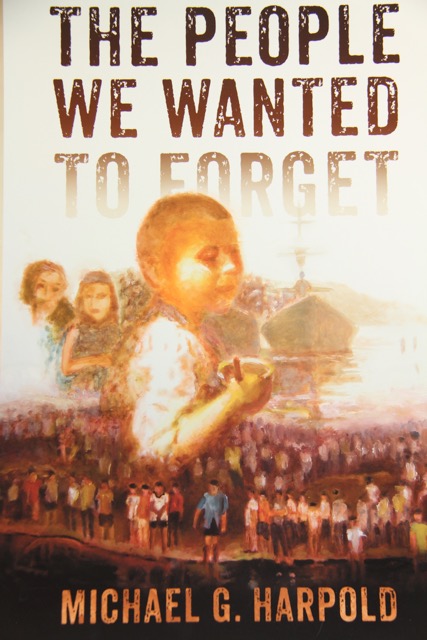
The People We Wanted to Forget

IMG_1614

PROLOGUE

Sunday Morning, January 18,1978, Songkhla, Thailand

Their eyes wide but unseeing as if they were prey gripped in the iron jaws of a predator, the refugees huddled in eerie silence on the open deck of their wooden fishing boat. Mothers and fathers, the men half-naked, clutched their children to their sides. They took no notice of our arrival. They know they’re going to die, I realized. My heart stopped.

Tethered to the stern of a steel-hulled Thai navy gunboat, their small boat, once painted light blue with gay red trim, was so over crowded I feared it would capsize the moment it left the dock. Twin .50-caliber machine guns mounted on the fantail of the naval vessel pointed menacingly down at the people. The throaty rumble of the ship’s diesel engines signaled its impatience to get under way.

American vice consul Bob Hayashida and I ran to a Thai official dressed in casual shirt and slacks, standing at the foot of the gunboat’s gangway, who appeared to be in charge.

“Can we talk to the people?” Hayashida asked.

“Yes,” the official answered, recognizing Hayashida. “But in ten minutes we are towing them out to sea—beyond Thai waters.”

“Can we talk to the vice governor?” Hayashida pressed.

“The vice governor is visiting in another province and cannot be contacted,” the official replied.

Hayashida and I had been at breakfast on the lanai of my hotel that pleasant Sunday morning when a French doctor with Médecins Sans Frontièrs pushed his way through the shrubbery to the rail and told us the Thai navy was preparing to tow a boat loaded with refugees back out to sea.

“The people are in poor shape,” the doctor said. “Many of the women have been raped, the men beaten. The children are sick from drinking seawater. I treated them as best as I could on the deck of their boat. I don’t believe they can survive another night at sea, especially the children,” the doctor added.

Praying that we would not be too late, we ran to Hayashida’s car and raced to the dock. It appeared that the vice governor of Songkhla was about to make good on the threat he had delivered at a reception the previous afternoon to visiting Deputy Assistant Secretary of State for East Asia and Pacific Affairs Robert Oakley, and more Vietnamese boat people were about to die.

Ambassador Oakley had flown to Songkhla to try to persuade the governor to treat refugees more humanely. I was in Thailand to gather facts about the Vietnamese boat people for a congressional hearing and had been given a seat on the embassy aircraft. When we had arrived the previous afternoon, Oakley had insisted that I attend the official reception where he somewhat grandly, I thought, introduced me as the special assistant to the commissioner of the Immigration and Naturalization Service.

At the reception, the vice governor would have nothing of Oakley’s plea for restraint. After relating the long history of the United States ignoring Thai pleas to take Vietnamese refugees off their hands, he proclaimed that he would continue to force refugee boats back out to sea until the United States started taking the Vietnamese from the overcrowded camp in Songkhla and resettled them elsewhere in the free world. Oakley had been unable to commit the United States to take in the refugees and earlier that morning had flown back to Bangkok.

Hayashida and I hurried back to the refugee boat.

“Who is the captain?” I asked, my Vietnamese grown rusty in the decade since I served in Vietnam. After some hesitation, a half-dozen men rose to their feet and identified themselves as the committee who made decisions for the group.

“How many are you?” I asked.

“We are thirteen men, five women, and sixteen children from Phuc Quoc Island,” a spokesman said. “We are three families.” One of the men retrieved a map, a page torn from a schoolbook, showing in four colors the countries along the rim of the Western Pacific, and pointed to a dot off the southern tip of South Vietnam.

“We want to go to Australia,” the spokesman said.

I shot Hayashida a puzzled look.

“They know the United States won’t take them,” the vice consul
said and looked away.

I winced but pressed on.

“Is this all you have to navigate?” I asked, astounded that they
would set sail on a 2,500-mile voyage having only a map torn from an elementary school textbook. From the wheelhouse, the men produced a compass mounted on a block of wood that had apparently been salvaged from the instrument panel of a wrecked aircraft.

“What will you do for food and water,” I asked.

“Nobody eats much because we are mostly sick from drinking sea water,” the spokesman said, and I dropped the issue.

The men related that they had set sail as part of a larger group of 180 from their village. On their first night at sea, they had become separated from the other boats. They had been at sea three days, they said. During the night, their motor had failed, and they had drifted into Songkhla.

“First, Thai pirates, and then even Thai fishermen, overtook our boat four times,” the men said. “They take everything we have: three watches, two rings, and two necklaces.” The spokesman showed me the welts where his watch was ripped from his wrist. The refugees managed to retain a single US twenty-dollar bill that one of the men had concealed in his rectum.

I asked about the herringbone-like rows of welts on the backs of several men.

“We are fishermen and the Communists made us give them our entire catch,” a man said. “They would not give us back enough food to feed our families. We are starving. We tried to flee before, but we were caught and beaten.”

“Where are your clothes?” I asked, gesturing to men clad only in underpants.

“Each time the Thais boarded us, they beat up the men and raped the women and girls, right in front of their children and husbands. They threatened to throw anyone who resisted into the ocean. Then they took the women’s clothing to shame them. Afterwards, the men gave up their clothing to the women.”

I looked at Hayashida; his grimace acknowledged our helplessness.

“We should take down their names,” he suggested. “Sometime, somewhere, someone may want to know what happened to them.” He retrieved a yellow legal pad from his car, and we began a task that I could equate only to a census of the doomed.

Our allotted time ticking away, my mind desperately churned for options. If the Thai gunboat started to leave the dock with the refugee boat in tow, I was certain I’d be forced to jump aboard the little fishing boat and be towed out to sea with them. Would the Thai sailors forcibly remove me, leaving my gambit for naught? If I succeeded in going out to sea with the refugees, and if a rescue failed to materialize or the small boat floundered, I could lose my life and have accomplished nothing.

But failing to act would leave me to face a lifetime of horror and self-doubt that I knew I would not be able to bear.

Or I could lie, try to convince the governor I had the authority to guarantee that the refugees would be taken to the United States. If I could get them into the camp, I’d have a chance to persuade my superiors in the State Department and the Justice Department to accept them as political refugees.

But would the vice governor believe me, or was this just wishful thinking? Ambassador Oakley had told him the previous day that the boat people were merely fleeing bad economic conditions, not political repression, and therefore were not eligible to be taken in by the United States. Any promise I made, valid or not, would not only contravene what Oakley had said but also underscore the shallowness of the US policy.

It occurred to me that I might be playing directly into the vice governor’s hand, but so be it, I thought. It appeared to be the only chance the people huddled on the boat had. There would be consequences for me. I was certain to lose my job and possibly would face criminal prosecution for misrepresenting my authority in an official matter, but there was no comparing a setback to my career with the loss of thirty-four innocent lives.

The pitch of the gunboats engines dropped. Sailors took their posts at the lines. The Thai official started towards Hayashida and me, signaling that our time was up.

Christmas 1969

I pressed my face to the window of the Northwest Orient DC-8, anxious, even in the pre-dawn black, to get my first glimpse of home. As the aircraft began a long, low approach towards SeaTac airport I could make out strip-malls, parking lots, and the neon lighting of an all-night cafe. Occasionally, a car’s headlights illuminated the snow-covered highway below. The aircraft straightened, paralleling an arterial street. We were low enough now that I could see snowflakes reflected in the streetlights.

Flaps down, engines powered for a landing, we cruised just a few hundred feet above the ground, over darkened houses their roofs outlined in red, green, blue and white Christmas lights. Strands of multi-colored bulbs draped the snow-laden limbs of conifers. Outdoor crèches and lighted snowmen stood vigil on front lawns. Wreaths graced front doors. Curtains pulled back, lighted Christmas trees, and in at least one home a lighted menorah, filled the windows of darkened living rooms. Occasionally, a lighted kitchen indicated life was astir; a mother or father preparing breakfast before heading off to work, or getting kids ready for school.

Why are their Christmas lights still on, I pondered? At our house, we turned the tree lights off before going to bed. Our neighbor’s outdoor displays were generally dark by eleven, certainly not left on all night.

It occurred to me at first as an errant fancy that I quickly dismissed. But then I remembered nearby Ft. Lewis and the thousands of servicemen and women who passed through SeaTac on their way to and from Viet Nam. What I was witnessing in the neighborhood below was not in a dream.

They’ve left their lights on for us!

I was in an instant exhilarated, and then I cried.

Those of us who served in Viet Nam that Christmas of 1969 had read reports of anti-war protests and student riots in the Armed Forces newspaper, The Stars and Stripes, and in letters from home. America was turning against the war. Soldiers traveling in uniform were met with cold stares. The polite ignored them. Stories circulated overseas of GIs being jeered and spat on. Although I was not traveling in uniform, I wondered what to expect when I arrived home.

But, in the homes beneath our landing path, south of SeaTac, families had left their lights on for us! That simple, heartfelt welcome home meant the world to me that Christmas, and I will never forget.

Mom’s Olson Rug

The dark-green Railway Express truck had never stopped at our house before, and for six-year olds its arrival that spring day was excitement aplenty. But thinking back on it over 70 years later, I realize now that the heavy, paper-covered cylinder from the Olson Rug Company in Chicago dropped on our porch that afternoon marked a victory for our mother against the chain of misfortune that had left her alone during the war years to raise three young children.

Dad lay in a hospital bed at the Lakeview Sanitarium above the shore of Lake Mendota in Madison, Wisconsin, sixty-five miles away, fighting for his life against the tuberculosis that had raged undiagnosed in his slight body until he began coughing up blood. He would remain hospitalized for three years, enduring surgery that removed the upper half of his right lung and most of his right shoulder muscles. Mom, a former teacher, was left alone to run our small neighborhood store, The Blue Ribbon Grocery, and raise us children. My twin brother, Pat, and I were four-years old that warm-summer evening in 1942 that Dad left for the san, our sister, Mary, just one.

Those dark years were made even worse by the advent of World War II. We listened to the war news each night over our small radio, its brittle plastic shell, shattered by impatient blows that at best delivered momentary relief from the static, held together by white tape. German armies surged across France and the Low Countries, then Norway, the Balkans, North Africa and now Russia driving the population of most of an entire continent from their homes. From London, Edward R. Murrow described the horror of the blitz, and through his words processed though our young minds, we vicariously experienced the terror.

The entire population of Europe was on the move, made refugees by the advances of the German army and its allies. German submarines operated at will off the east and Gulf coasts. Tankers and freighters were sunk often within sight of the port from which they sailed. After Pearl Harbor, the Japanese continued to roll over Southeast Asia, The Dutch East Indies, and US territory in the Philippines, Guam and Alaska. Even deep in the midwest, we participated in weekly blackout drills, closing the heavy, dark curtains over our windows and dousing all lights save the one Mom used to read to us.

It was uncertain that the U.S. itself would escape invasion, or that the US and its allies would win this war. In later years, Mom told us that at the time she wished we at least 14 years old so we could care for ourselves if the worst happened and we were forced from our home.

Having been left alone to run our small, neighborhood store, The Blue Ribbon Grocery, on the highway at the southend of town, and not having a car, Mom rented a small, white, wood-frame house on the next block from the store across the street from the Richland Co-op Creamery. We came to know it as the Little House. We moved in on a cold, November day, and those first nights, a corpulent aunt slept between Pat and I while mom slept with our little sister, Mary. When Mom was at the store, we were left in the care of a succession of hired help.

Resting on a crumbling stone foundation and a partial basement little more than a root cellar, the wood and linoleum floors of the un-insulated house were as cold as the frozen ground underneath. On cold mornings, we crawled out of our snug bedding and slipped our bare feet into our shoes. We carried our clothes into the living room and warmed them against the kerosene stove before jumping out of our pajamas and pulling on our trousers. It was the only place in the house where we could stand on the floor in our bare feet.

The stove became the center of our play, the place in later years where we would do our homework, and at bedtime where we changed into our pajamas. We could see the flames jumping cheerily through an isinglass window. When we came in from play after school, we sat in front of it and broke the ice from the cuffs of our long underwear. Three steps in a snow bank were enough to pull our trousers out of the tops of our rubber buckle boots allowing snow to pack in around our ankles. From November into April, we sported a ring of black chap there.

A coal stove heated the kitchen, and when we were big enough, Pat and I took turns lugging in scuttles of coal from the shed at the rear of the house and hauling out the ashes. Of necessity, mom bought the cheapest grade of coal, large chunks that had to be chopped up with an old axe before it would fit into the firebox. We took turns hauling in buckets of oil for the living room stove also, and woe be it to whoever let the stove run out.

The Little House did not have a hot water heater, and mom heated up pans and kettles of water for the dishes and our baths on a white-enamel kitchen range fueled by white gas. Nor did we have a refrigerator. An icebox sat on the back porch, just outside the back door. Above the icebox in the cold, humid air, Mom hung a cloth bag of popcorn. When popped, the kernels exploded into large white puffs, a treat – one of our only ones – each Sunday night after supper.

Late in the fall, in preparation for our long, Wisconsin winter, mom, helped by a neighbor, tacked a wide strip of black tarpaper around the foundation of the house. It was our job to rake leaves up against the tarpaper. Mom planted parsnips in the leaves, and later in the winter, with mittened hands, we dug down through the snow and composting leaves to harvest them.

After taking down the screens and putting up the storm windows, mom and her helper tacked panels of quilted isinglass over the doors and windows. The opaque covering admitted light but prohibited a clear view outside. It felt like we were living in a cocoon, and when in April the isinglass panels were peeled away and we could see the colors and experience the fresh, scented air of spring, we felt reborn.

But of all the things we needed or could use, a warm carpet for the living room was at the top of our mother’s list. In the war years, however, even if we had the money consumer goods were hard to come by. Everything, including wool for carpets, went to the war effort.

Unable to get wool because of wartime shortages, the Olson Rug Company offered to weave carpets from woolen rags provided by the customer. When mom learned of the offer, she began hoarding old woolens. In those years, we were blessed with a surfeit of hand-me-downs from people who knew of our plight. I imagine she also had help from her customers at the store. I do not know how long it took mom to hoard enough wool rags to make a carpet, but she did it.

The deliverymen had no sooner departed than Pat, trailed by Mary, ran up the street to the store to get Mom, but, still wearing her apron she was already on her way up the sidewalk. Impatient, Pat and I ripped and tore at the heavy paper covering and soon we laid bare the grey-fiber underside of a carpet rolled tightly around a heavy bamboo pole. Mom stood beaming.

Our neighbor, Kitty Durst, appeared, and she and our hired girl helped mom move our few threadbare pieces of living room furniture into the kitchen or out onto the porch. Barely allowing Mom time to sweep out the empty room, Pat and I helped lug the heavy roll in through the screen door. She stood back, beaming, as Pat, Mary and I dropped to our knees and un-rolled the stiff, new carpeting onto the bare floor. The oil stove was somehow lifted, the carpet slipped under it, the asbestos sheet it stood on replaced, and the stove set back down. Seconds later, we romped on the wine-colored wool rug.

With our new carpet, our living room became an inviting place. We no longer had to play on our cold, bare floor or wait for a playmate to invite us to romp on the warm, carpeted floor at their house. Friends would come to our house now. In those years, there was little new in any home, but Pat and I finally had something to brag about.

We had good news about dad, also. After years of bed rest, he had grown strong enough to undergo surgery. He would lose half a lung and the muscles in his right shoulder, but he would come home. After a long summer of recuperation, he would once again take over the running of our store.

With dad’s touch for retailing, and in the post-war prosperity, the Blue Ribbon Grocery thrived. We bought our first car. A new brother and sister joined us, John Timothy and Elizabeth Anne, and in 1949 we moved to a new, much larger house on North Central Avenue, and we no longer had to walk the mile to St. Mary’s school and back each day.

In the darkest moments of our lives, mom’s Olson rug had helped us past the turning point. Today, Mary, Pat, and I recollect the countless hours we played, read books or did our homework on that warm, burgundy rug under the watchful eye of the dancing orange flame in the isinglass window of the living room stove. But in retrospection, having ourselves had the responsibility of raising our own families, we think of our mother and the satisfaction she must have felt the day the Olson rug arrived.

A TIME TO FORGIVE

“It offends my friend, John King,” the white, middle-aged, Republican legislator pointed dramatically toward the black lawmaker as she pleaded from the floor of the South Carolina legislature.

“It offends my friend, Reverend Neal,” her voice rose to a shout, so fraught with emotion it appeared she would be unable to finish.

“It offends my friend Mia McLeod!” the lawmaker, State Representative Jenne Horne, pointed at yet a third black legislator and demanded action.

Late at night on C-SPAN, two weeks after the slaying of a black pastor and eight members of his flock in the sanctuary of the Emmanuel AME Church in Charleston by a white supremacist, I had chanced on the televised debate over removing the Confederate flag from the South Carolina State House grounds. Sensing that I was witnessing an historic turning point in what I understood of the South and a moment meaningful in my own life, I sat riveted by the unexpected emotion of the speaker. Continue reading

Jobs Are Precious For Immigrant Workers Too

Dear Editor,

The State Department J-1 program should not be used to bring temporary workers from foreign countries to work in Alaska canneries as advocated by Senator Murkowski. (J-1 Visa extension? Ketchikan Daily News, July 11-12, 2015.)

This widely discredited program that each summer under the guise of cultural exchange brings over 350,000 foreign students to the U.S. to work is nothing but a thinly disguised temporary worker program that displaces American workers, immigrant and U.S. citizen alike.

I spent the last fifteen of my 35-year career in the United States Immigration Service enforcing immigration laws in Southeast. When I arrived in Ketchikan, foreign students holding tourist visas took a sizable percentage of cannery jobs. In 1987 the practice was stopped and cannery wages rose from $4.35 to $6 an hour.

Continue reading

The Red Cat’s Eye

I miss Jerry a lot; he was my best friend. The sheriff said he fell out of the tree and cracked his head on a root. That’s not the way it happened, but nobody believes me. Now Dad says we’ve got to let things be and move on.

I can look up the next block across the street and see that big tree from our front yard; the top goes way up over that old house. Its leaves have almost all fallen now, but no one has bothered to rake them up. The yard is all brambles and tall weeds ‘cept for under the oak tree where nothin’ seems to grow.

Most of the paint has peeled off the walls of the house, but you can tell it had been painted white once. It’s weird that the windows still have glass in them. Everyone says the house is abandoned; they said that when we first came to town, but I’ll never believe it. Nobody has ever seen a light in the window. Some things don’t need light to live by, that’s why.

Continue reading

Until Mommy Comes Home

“Daddy, Rosie ate the Easter eggs,” Elizabeth announced as I shuffled into the living room still in my bathrobe. She and Sarah were sitting cross-legged on the couch in their nighties examining the contents of their Easter baskets: multi-colored jelly beans, an assortment of foil-wrapped candy eggs, a giant chocolate bunny, and Peeps, little yellow marshmallow chickens.

I looked behind the door, behind the TV, the base of the floor lamp, and the back corner of the couch. Empty nests of green Easter grass marked the locations where just a few hours earlier I had hidden pastel-colored eggs. I rushed into the kitchen. Lying on her belly, her tawny muzzle flattened on the linoleum floor in front of her water bowl, our Golden Retriever, Rosie, looked up at me with her big brown eyes and thumped her furry tail just once. “Br-a-a-a-p!!” she belched, and looked away.

Continue reading

PRIVATE SECRET AGENT MAN; A Stranger Arrives in Ketchikan, Alaska — And Stays

A lone man sat at the Formica table in the galley. His thin face was framed by ratty-brown hair that curled on the shoulders of his dirty, blue-woolen shirt. He held a fork upright in his left hand a steak knife in the other while he continued to chew on a last piece of meat. Like a European, I thought.  He turned his face toward me, but did not speak. I wondered if he was seeing me. Or, was his gaze fixed on something else, some place or time far, far away?

“He’s a hungry one,” the cook said, grinning at his guest. “But, we got him warmed up, and fed, I think.” The inviting smell of coffee and fresh baked bread gave the steel-walled galley of the Aqua-Train tug a comfortable feel.

“The mate found him sleeping under a railcar on the barge,” the captain explained. “He must have snuck aboard while we were loading cars in Prince Rupert.”

Continue reading